
Lost in Morocco: Medinas, Deserts, and the Magic of Chefchaouen
From the labyrinthine souks of Marrakech to the star-dusted silence of the Sahara, and the dreamy blue alleys of Chefchaouen — Morocco is a journey that rewires your senses. Here's everything you need to know before you go.
A Kingdom That Defies Description
There are countries you visit, and then there are countries that visit you — that settle into your bones and refuse to leave long after you've returned home. Morocco is emphatically the latter. From the moment you step off the plane and into the warm, spice-laden air, you understand that something extraordinary is about to happen.
Morocco sits at the crossroads of Africa, Europe, and the Arab world, and that confluence is written into every tile, every tagine, every call to prayer that echoes across its ancient medinas. Over two weeks, I traveled from the frenetic heart of Marrakech to the edge of the Sahara Desert, then north to the impossibly blue mountain town of Chefchaouen — and every single day delivered something I hadn't anticipated.
"Morocco doesn't just show you another world. It makes you question the one you came from."
This is the story of that journey: the wrong turns that became the best turns, the meals that made me weep with pleasure, and the landscapes that no photograph can fully contain.
Marrakech: The City That Never Stops Moving
Marrakech arrives like a fever dream. The taxi from Menara Airport deposits you at the edge of the medina — the old walled city — and from that moment, the sensory overload is total. Motorbikes thread through alleys barely wide enough for a single person. Vendors call out in French, Arabic, Darija, and whatever language they sense you might speak. The smell of cumin, leather, and charcoal smoke hangs in the air like a permanent perfume.
The medina of Marrakech is a UNESCO World Heritage Site, and wandering its souks is one of the great travel experiences on earth. Each quarter specializes in its own craft: the dyers' souk, where skeins of wool hang in vivid saffron and indigo; the leather souk, where artisans hammer and stitch by hand; the spice market, where pyramids of ras el hanout and dried rose petals compete for your attention. Getting lost here is not a failure — it is the entire point.
- Djemaa el-Fna Square: The beating heart of Marrakech, this vast plaza transforms throughout the day. By morning, orange juice vendors and argan oil sellers hold court. By evening, it becomes one of the world's great open-air theatres: snake charmers, acrobats, storytellers, and dozens of smoking food stalls materializing out of nowhere.
- The Bahia Palace: A 19th-century masterpiece of Moroccan architecture, with intricately carved cedarwood ceilings, zellij tilework, and serene courtyard gardens.
- The Majorelle Garden: Designed by French painter Jacques Majorelle and later restored by Yves Saint Laurent, this cobalt-blue botanical garden is a rare pocket of calm in the city's chaos.
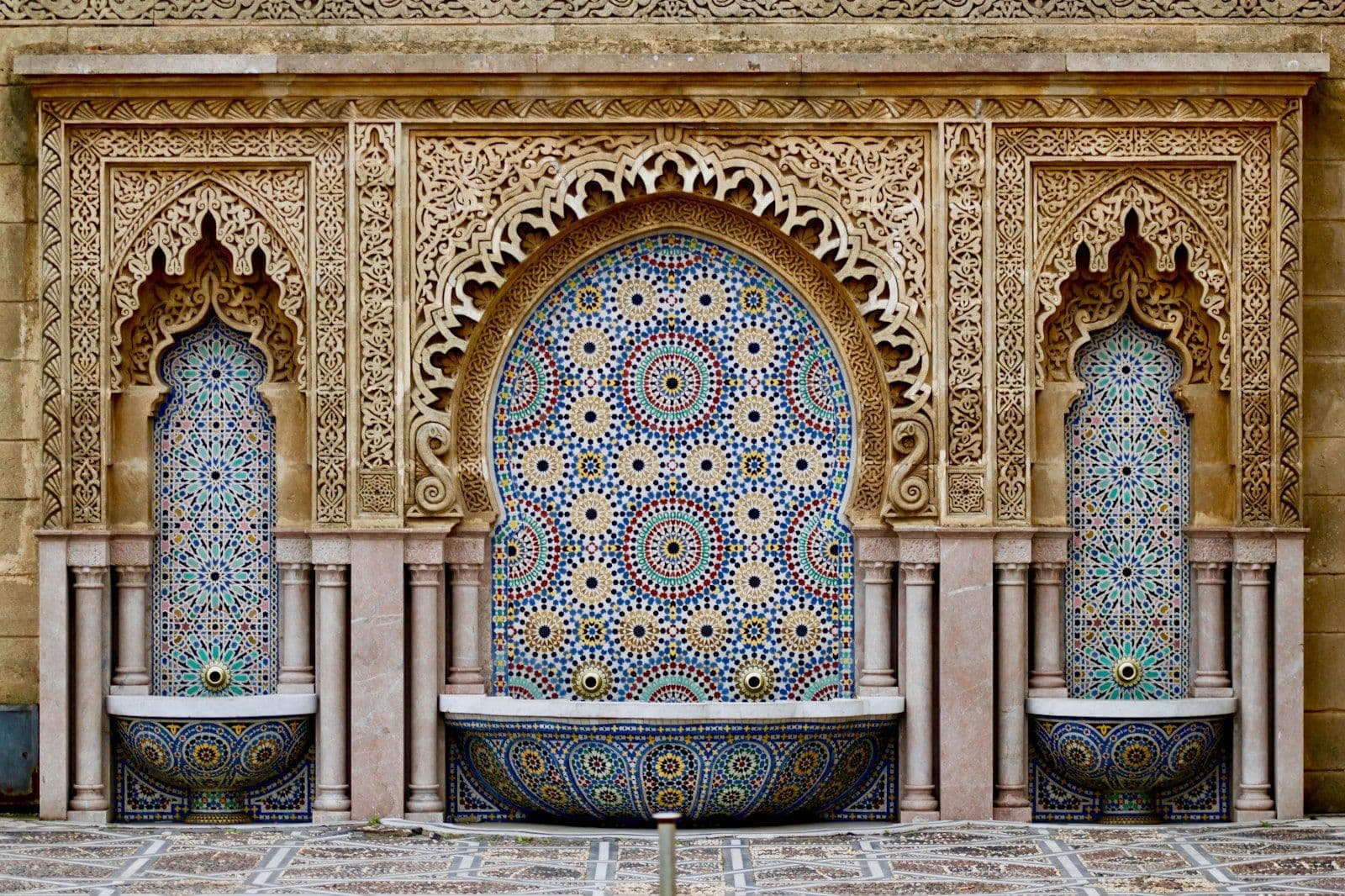
- Riads: Stay in a riad — a traditional Moroccan house built around a central courtyard — and you'll understand why visitors extend their stays. Behind an unassuming wooden door lies a world of mosaic fountains, orange trees, and rooftop terraces with views across the medina's rooftops to the Atlas Mountains beyond.
"In Djemaa el-Fna at dusk, with smoke rising from a hundred grills and the muezzin calling from the Koutoubia Mosque, you feel the full, magnificent weight of a civilization that has been doing this for a thousand years."
Allow yourself at least three full days in Marrakech — and resist the urge to plan every hour. The city rewards those who wander without agenda. Duck into a courtyard café for a glass of mint tea. Follow the sound of hammering to find a craftsman at work. Let the medina swallow you whole.
The Sahara Desert: Where the World Goes Quiet
The drive from Marrakech to the Sahara takes you over the High Atlas Mountains via the Tizi n'Tichka pass — a serpentine road that climbs to over 2,200 metres and delivers views of snow-capped peaks, Berber villages clinging to cliffsides, and valleys of almond and walnut trees. It is, in itself, one of the most spectacular drives in Africa.
The desert proper begins near Merzouga, where the Erg Chebbi dunes rise abruptly from the flat hammada — some reaching over 150 metres. Nothing quite prepares you for your first sight of them: vast, sculpted waves of orange sand, shifting and reshaping with every wind, stretching to the Algerian border and beyond.
- Camel trekking: The classic approach to the dunes is by camel at sunset, when the light turns the sand every shade of amber and rose. Your guide leads the caravan in near-silence, and the only sounds are the soft padding of hooves and the occasional sigh of the wind.
- Desert camps: Spend the night in a luxury desert camp — a cluster of Berber-style tents furnished with rugs, lanterns, and proper beds — positioned deep in the dunes. The hospitality is extraordinary: a dinner of slow-cooked lamb, bread baked in the sand, and sweet mint tea served under a canopy of stars.
- Stargazing: With zero light pollution for hundreds of kilometres, the Sahara sky at night is one of the most humbling sights available to a human being. The Milky Way is not a suggestion here — it is a blazing river of light overhead, so dense and bright it seems almost artificial.
- Sunrise in the dunes: Wake before dawn and climb the nearest high dune to watch the sun rise over the Algerian border. The cold of the desert night gives way to warmth in minutes, and the dunes shift from silver to gold to deep copper as the light changes.
"Lying on my back in the Sahara at midnight, I understood for the first time what silence actually sounds like. Not the absence of noise, but a presence — vast, ancient, and completely indifferent to human urgency."
The Sahara has a way of recalibrating your sense of scale. In the dunes, you are very small, and the world is very large, and somehow that is exactly what you needed to be reminded of.
Chefchaouen: The Blue Dream of the Rif Mountains
If Marrakech is Morocco at full volume, Chefchaouen is Morocco in a whisper. Tucked into the folds of the Rif Mountains in the country's northwest, this small city has been painting its walls, steps, and doorways in shades of blue for centuries — a tradition with roots in Jewish heritage and a practical purpose (blue reportedly repels mosquitoes) that has become one of the most photographed streetscapes on earth.
But Chefchaouen is far more than an Instagram backdrop. It is a genuinely liveable, deeply human place: a city where cats sleep on blue-painted steps, where old men play cards in shaded squares, where the smell of kif mingles with woodsmoke on cool mountain evenings. The medina here is smaller and far less frenetic than Marrakech's, and the pace of life is correspondingly gentler.
- The medina: Wander the blue-washed alleyways of the old quarter at any hour and find something worth photographing — a doorway draped in bougainvillea, a cat curled on a mosaic step, a shaft of mountain light cutting through a narrow passage.
- Plaza Uta el-Hammam: The main square, anchored by the Grand Mosque and the old kasbah, is the social heart of the city. Sit at a café table and watch the world pass for an hour.
- Hiking to the Spanish Mosque: A 45-minute walk up the hillside above the medina brings you to a ruined Spanish mosque with panoramic views over the blue rooftops and the mountains beyond — especially magical at sunset.
- The souks: Chefchaouen's markets specialize in woven wool blankets, djellabas, and locally produced goat cheese — far less touristy than Marrakech and correspondingly more rewarding to browse.
"There is a particular quality of light in Chefchaouen in the late afternoon — blue walls catching the golden hour, shadows pooling in doorways — that makes you feel as though you've wandered into a painting that hasn't quite dried yet."
Stay at least two nights. The city reveals itself slowly, and the best moments come when the day-trippers have gone and the streets belong again to the people who actually live here.
Moroccan Cuisine: Eating Your Way Across the Kingdom
To travel Morocco without eating deeply and adventurously is to miss half the country. Moroccan cuisine is one of the great culinary traditions of the world — a sophisticated, layered cooking culture shaped by Berber, Arab, Andalusian, and sub-Saharan African influences, and built on a pantry of spices, preserved ingredients, and slow-cooking techniques that produce flavours of extraordinary complexity.
Here is what you must eat, and where:
- Tagine: The iconic slow-cooked stew, named for the conical clay pot it's cooked in. Lamb with prunes and almonds; chicken with preserved lemon and olives; vegetable tagine fragrant with ras el hanout — each version is a lesson in patience and balance. Eat it with torn khobz bread, never a fork.
- Couscous: Traditionally served on Fridays, the Moroccan day of communal gathering, couscous here bears no resemblance to the instant variety. Hand-rolled semolina, steamed three times over a broth of slow-cooked vegetables and meat, it is a dish of profound comfort and ceremony.
- Mint tea: Moroccan mint tea — atay — is not merely a drink. It is a ritual of hospitality, poured from a height to create a froth, sweetened with alarming quantities of sugar, and offered to every guest as a matter of course. To refuse it is to refuse friendship.
- Street food in Djemaa el-Fna: The night market in Marrakech's main square is one of the world's great street food experiences. Merguez sausages sizzling on open grills; bowls of harira soup thick with chickpeas and lentils; skewers of kefta; snail broth ladled from enormous pots. Point at what looks good and eat standing up.
- Pastilla: A Fassi speciality — a flaky pastry pie filled with pigeon (or chicken) and almonds, dusted with cinnamon and powdered sugar. Sweet and savoury at once, it is one of the most surprising and delicious things you will eat anywhere.
- Argan oil: Produced only in Morocco from the fruit of the argan tree, this nutty, golden oil is drizzled over amlou (a paste of almonds, honey, and argan oil) and served with bread for breakfast. Buy a bottle to take home — nothing else will taste quite right afterwards.
"A good tagine is an argument for slowing down. It cannot be rushed. The flavours only arrive after hours of patient heat, and they reward you accordingly — deep, warm, and completely unhurried."
Eat in small, family-run restaurants rather than tourist-facing establishments. Ask your riad host for recommendations. Follow the locals at lunchtime. The best meals in Morocco are rarely the ones you planned.
Coming Home: What Morocco Leaves Behind
I flew home from Casablanca on a grey Tuesday morning, my bags heavy with saffron, argan oil, a hand-knotted rug I had no room for, and a djellaba I will probably never wear but couldn't leave without. My phone was full of photographs that, I already knew, would fail to convey what I'd actually seen.
Morocco does something to you that is difficult to articulate. It is not simply that it is beautiful — though it is, extravagantly so. It is that it operates at a different frequency from the world most of us inhabit: slower in some ways, more intense in others, more willing to sit with complexity and contradiction. The call to prayer and the nightclub. The ancient medina and the rooftop bar. The desert silence and the market cacophony. Morocco holds all of it, simultaneously, without apology.
If you haven't been, go. Go soon, go with an open itinerary, and go hungry — for food, for colour, for the particular kind of disorientation that only travel can provide. Morocco will meet you more than halfway.
"The best souvenir I brought back from Morocco wasn't in my luggage. It was the habit, still with me months later, of pausing before I rush — of remembering what it felt like to sit in a riad courtyard with a glass of mint tea and nowhere urgently to be."